
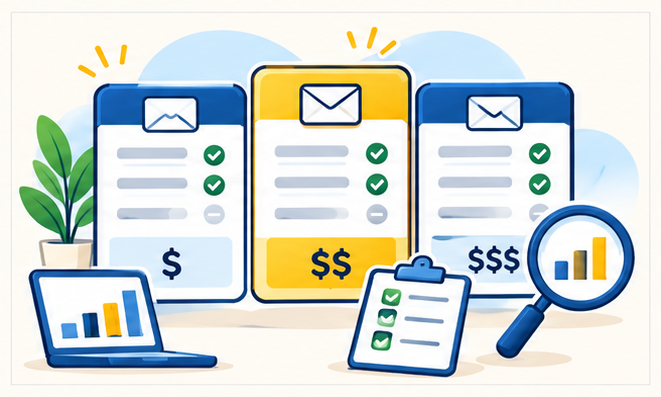
Why price and accuracy are not the same thing
Email verification relies on DNS records, mail-server behavior, SMTP responses, provider-specific restrictions, infrastructure, and the rules a verifier uses to interpret incomplete evidence. The guide on how accurate verifiers can be covers those limits in more depth.
A higher price can reflect integrations, support, enterprise contracts, deliverability tools, reporting, or broader product features. None of those automatically prove that the core mailbox classification is more accurate.
Likewise, a lower-priced service is not automatically cutting corners on the actual verification step.
Be careful with advertised accuracy percentages
Accuracy claims are difficult to compare because providers may test different datasets, use different definitions, or measure success against different outcomes.
A meaningful comparison would require the same addresses, checked at roughly the same time, with known ground truth and a consistent scoring method.
Without that, a headline percentage is marketing context, not a clean apples-to-apples benchmark.
Want to check an email while you’re here?
Use DD Verify to check an address yourself. You’ll get the verification result plus the underlying signals we can safely surface.
Check an email
Need to verify a full list?
Use DD VerifyLook at how the tool handles uncertainty
One of the strongest signals of a careful verifier is whether it is willing to say it does not know. Forcing every address into Valid or Invalid can create a cleaner-looking report while hiding genuine uncertainty.
DD Verify uses Unknown when the available evidence is not strong enough for a reliable conclusion. Unknown results do not consume purchased credits.
That does not mean more Unknown results are always better. It means uncertainty should remain visible when the system cannot support a stronger claim.
Catch-All handling is another important test
Catch-All domains can accept both real and fabricated recipients, which makes ordinary mailbox probing less conclusive. See the guide to Catch-All handling for how this works.
A tool that treats every accepted address on a Catch-All domain as confidently Valid may be making a stronger claim than the evidence supports.
DD Verify keeps Catch-All as a separate result so domain behavior is not confused with proof of the individual mailbox.
How to compare two verifiers yourself
Take the same sample and run it through both tools. Include known good addresses, known bad addresses, Catch-All domains, role accounts, and difficult corporate mail gateways.
Then compare where the tools agree, where they disagree, how many addresses come back inconclusive, and whether either tool makes confident calls you already know are wrong.
Testing your own data is more informative than assuming price is a proxy for quality.
- Use the same sample in every tool
- Include addresses with known outcomes
- Separate Catch-All from Invalid
- Track Unknown or unverifiable results
- Compare credit usage as well as classifications
Cheap can still be good value
The right question is not whether cheap tools are accurate. It is whether a specific tool gives you trustworthy enough results for your workflow at a price that makes sense.
DD Verify publishes its pricing, keeps uncertainty visible, and does not claim perfect certainty where the receiving infrastructure does not provide it.
You can test DD Verify with the same sample you use elsewhere and compare the results directly.
Common questions
Are cheap email verification tools less accurate?
Not necessarily. Price can reflect many product features beyond verification accuracy. The best comparison is a shared test set with known outcomes.
How can I test email verification accuracy?
Run the same representative sample through multiple tools and compare results against addresses whose real outcomes you already know.
Why do email verification tools disagree?
They may use different infrastructure, evidence thresholds, provider-specific logic, and policies for Catch-All or Unknown results.
Final thoughts
A cheap email verification tool can be accurate, and an expensive one can still be wrong. Price alone does not tell you how good a verifier is. The better questions are how the system handles uncertainty, whether it separates Catch-All from mailbox validity, how transparent the result model is, and how well the tool performs on a representative sample of your own data.
Want to check an email while you’re here?
Use DD Verify to check an address yourself. You’ll get the verification result plus the underlying signals we can safely surface.
Need help improving your business data?
DataDabble can research, clean, enrich, and maintain the records your team depends on.


