What data enrichment actually adds
Data enrichment starts with a record you already have. The starting point might be a company name, domain, email address, CRM record, location, product identifier, or another reliable key. Enrichment uses that starting information to locate missing context and add it to the record in a structured way.
For B2B teams, company enrichment can include industry, employee count, headquarters, locations, revenue range, ownership, or technologies used. Contact enrichment can include a current role, department, seniority, business email, public professional profile, or source link. Operational enrichment can be just as important, including standardized categories, identifiers, status fields, verification dates, or fields required by another system.
The strongest enrichment scopes are defined backwards from the decision. If sales routes accounts by employee count and industry, those fields deserve a stricter quality rule than an optional field nobody uses. Critical migration fields may deserve the same treatment.
- Company attributes: industry, size, locations, ownership, revenue ranges
- Contact attributes: current role, department, seniority, business email, public profile
- Technographic attributes: software or technology signals that change targeting
- Operational attributes: identifiers, standardized categories, source URLs, verification dates
A practical data enrichment workflow
Treat enrichment as a sequence, not a lookup. First define the finished record. Write the required fields, accepted formats, preferred sources, and what counts as verified. This prevents the project from expanding into a collection exercise where every available field gets added simply because a provider offers it.
Next, profile the starting data. Check whether the records are identifiable, whether duplicates already exist, and whether the source values are current enough to use as matching keys. Enriching against a bad company match or stale contact record can produce a more complete version of the wrong record.
Then source missing values. One provider may be enough for common fields, while specialized or high-value fields can require multiple sources or manual research. Use a source hierarchy that fits the field, such as official company information for company facts and current public professional information for roles.
Finally, standardize and review the output. DataDabble's internal QA process illustrates why this layer matters: the workflow checks whether companies still match the project criteria, verifies required contacts and titles, spot-checks public profile accuracy, checks websites and phone numbers when applicable, flags duplicates, and validates emails before delivery. A successful lookup is not the same thing as a ready-to-use record.
- Define the finished record and the purpose of each field
- Profile the starting data and identify match risks
- Choose sources by field instead of using one source for everything
- Enrich required fields first, then optional fields
- Standardize formats and control duplicates
- Verify high-impact fields before delivery or import
Data enrichment vs. cleaning and validation
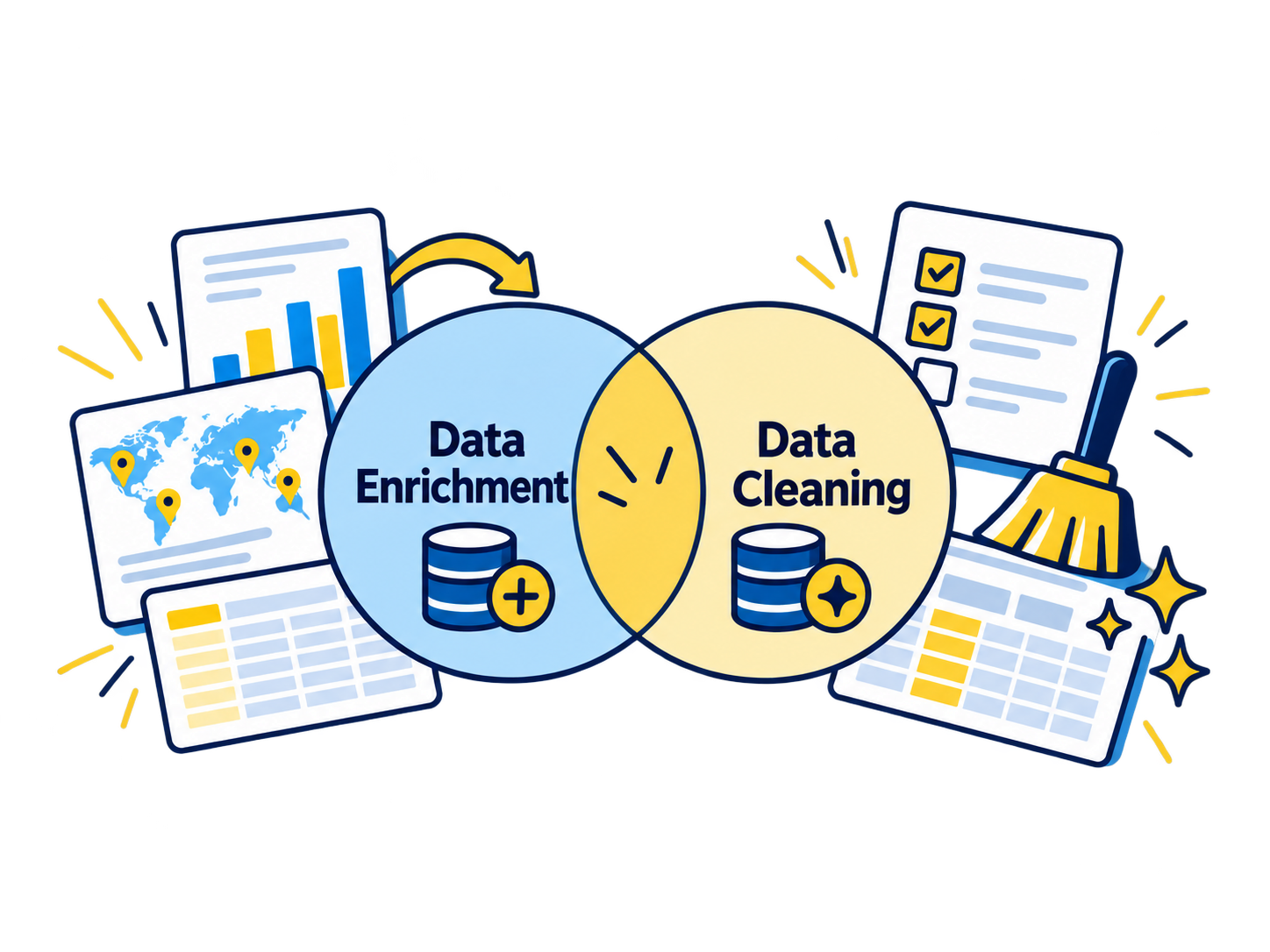
Enrichment, cleaning, and validation often happen together, but they solve different problems. Cleaning corrects or standardizes information that is already present. Validation checks whether a value follows a rule or agrees with a trusted reference. Enrichment adds context that is missing.
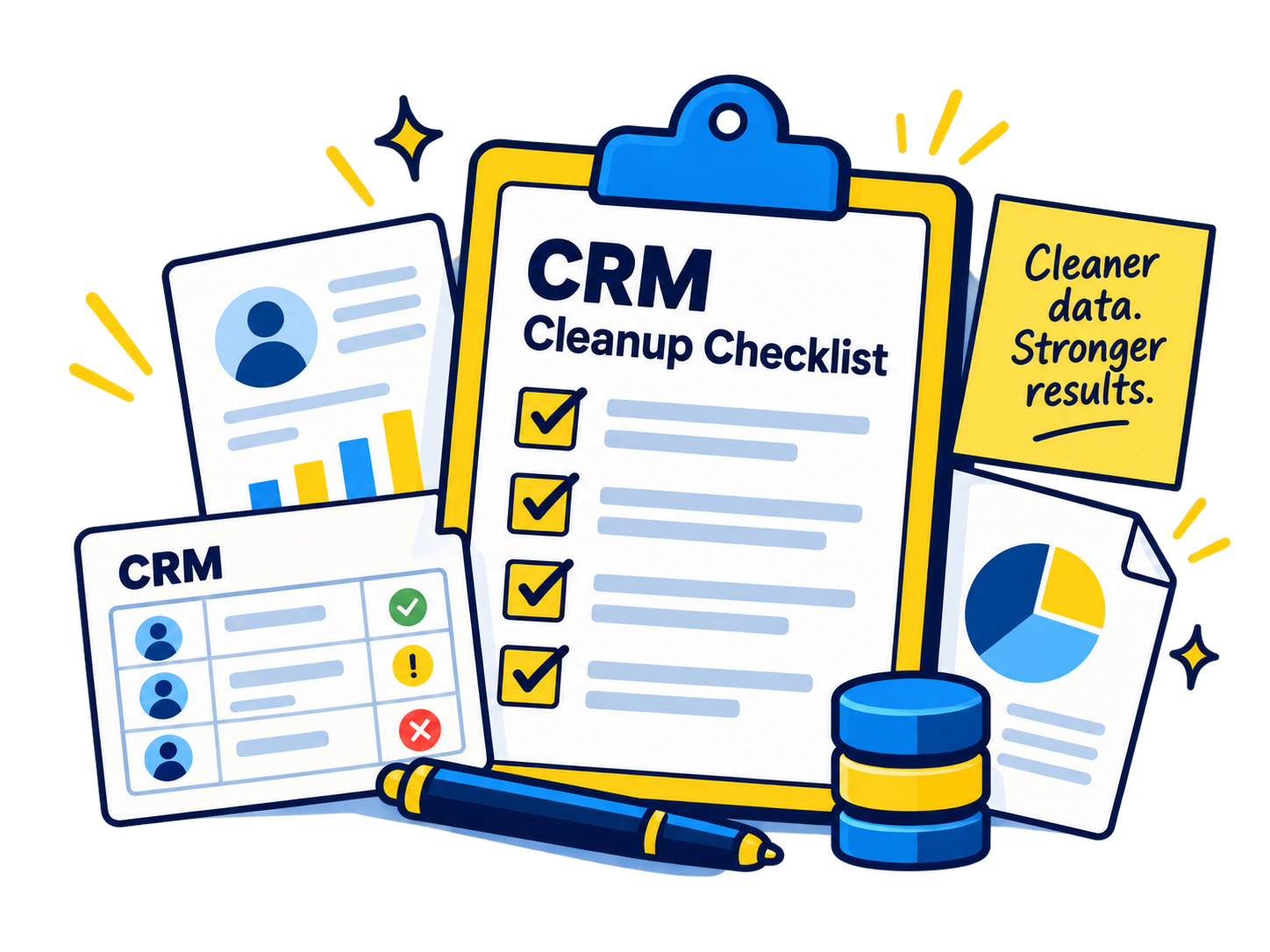
Consider a CRM contact with an outdated title, no employee count, an inconsistent company name, and a duplicate record. Cleaning can standardize the company name and resolve the duplicate. Validation can test whether the email format and domain are usable. Enrichment can add the current title, employee count, industry, or other fields needed by the team.
This distinction protects teams from a common mistake: treating populated fields as proof of quality. A field can be complete but wrong, valid in format but stale, or newly enriched but inconsistent with the rest of the database. The best enrichment workflows sit inside a broader data-quality process.
Which fields are worth enriching?
The fastest way to control cost and complexity is to rank fields by business impact. Ask what someone will do differently once the field is present. If the field changes qualification, routing, segmentation, reporting, system readiness, or an operational decision, it has a clear purpose. If nobody can explain how the field will be used, it probably belongs in the optional bucket.
Separate required fields from helpful fields. Required fields should have an explicit source rule and quality threshold. Helpful fields can be added when the source is reliable and the cost is reasonable, but they should not delay the fields the workflow actually depends on.
This approach also makes provider selection easier. Instead of asking which platform has the most fields, you can ask which method reliably covers the fields that matter to your use case.
- Tie each field to a decision or workflow
- Define required and optional fields before enrichment starts
- Set a source rule for every critical field
- Set formatting and verification rules before bulk work begins
- Avoid collecting fields simply because they are available
How to judge enrichment quality
Coverage is useful, but it is not enough. Data quality should be judged at the field level and against the intended use. IBM's widely used data-quality dimensions include accuracy, completeness, consistency, timeliness, validity, and uniqueness. Those dimensions translate well to enrichment because they force teams to ask more than whether a cell is filled.
Completeness asks whether required values are present. Accuracy asks whether they represent reality. Timeliness asks whether they are current enough for the use case. Validity checks whether the value meets a format or allowed-value rule. Consistency checks whether related records and systems agree. Uniqueness helps control duplicates that can distort outreach, reporting, and workflow logic.
For high-impact contact fields, source traceability and verification matter too. If a title or business email cannot be confidently confirmed, the record should not be treated the same way as a verified one. Uncertainty is a data point, not something to hide.
- Completeness: required values are present
- Accuracy: values match a trusted reference
- Timeliness: information is current enough for the task
- Validity: values meet defined formats and rules
- Consistency: related systems and fields agree
- Uniqueness: duplicate records are controlled
Tool, in-house research, or enrichment partner?
Self-service enrichment tools are efficient when the target segment is broad, the required fields are common, and the returned data needs little judgment. HubSpot, for example, supports automatic, continuous, individual, and bulk enrichment of eligible CRM records, showing how enrichment can become part of an ongoing system workflow rather than a one-time project.
In-house research can make sense when the project is small, strategically sensitive, or dependent on internal knowledge. The tradeoff is capacity because skilled employees still have to research, check, standardize, and document each field.
A human-supported partner becomes more useful when criteria are narrow, sources disagree, fields require judgment, or the output follows a custom schema. The value is the research and quality-control layer around the data.
When enrichment creates the most value
Enrichment works best when the starting data is reliable enough to identify the correct record but incomplete enough to limit action. A CRM with known companies but missing firmographics is a strong candidate. A target-account list with company names but no current decision-makers is another. A product catalog with valid SKUs but missing channel attributes can also benefit from enrichment.
It is less useful when the starting data is fundamentally unreliable. If company names do not resolve cleanly, identifiers conflict, or duplicate rates are uncontrolled, enrichment can amplify the problem. In those cases, profile and clean the data first.
The practical rule is simple: understand the dataset before you enrich it. Know what is missing, why it matters, where it should come from, and how the result will be checked. That is what turns enrichment from a bulk append into decision-ready data.
Common questions
What is data enrichment?
Data enrichment is the process of improving existing records by adding relevant information from other sources so the data becomes more complete, current, or useful for a specific business purpose.
What is an example of data enrichment?
A company record containing only a business name and website could be enriched with industry, employee count, headquarters, locations, decision-maker information, source links, and verification dates for use in segmentation or outreach.
Is data enrichment the same as data cleaning?
No. Cleaning corrects or standardizes existing values. Enrichment adds missing context. Validation checks whether values meet rules or match trusted references. A strong data workflow often uses all three.
Does data enrichment always require multiple providers?
No. One reliable source may be enough for common fields. Multiple sources or manual research become more useful when coverage is incomplete, criteria are niche, or high-impact fields need stronger verification.
Final thoughts
Data enrichment improves an existing record by adding information that makes it more complete, current, or useful. The useful part matters most. A dataset with twenty new fields is not automatically better than one with six accurate fields that help a team qualify an account, route a lead, prepare a system import, or make a decision. Good enrichment starts with the business use case, defines the fields that matter, matches each field to a defensible source, and verifies the result before the data enters a workflow.
Need help improving your business data?
DataDabble can research, clean, enrich, and maintain the records your team depends on.