What counts as firmographic data
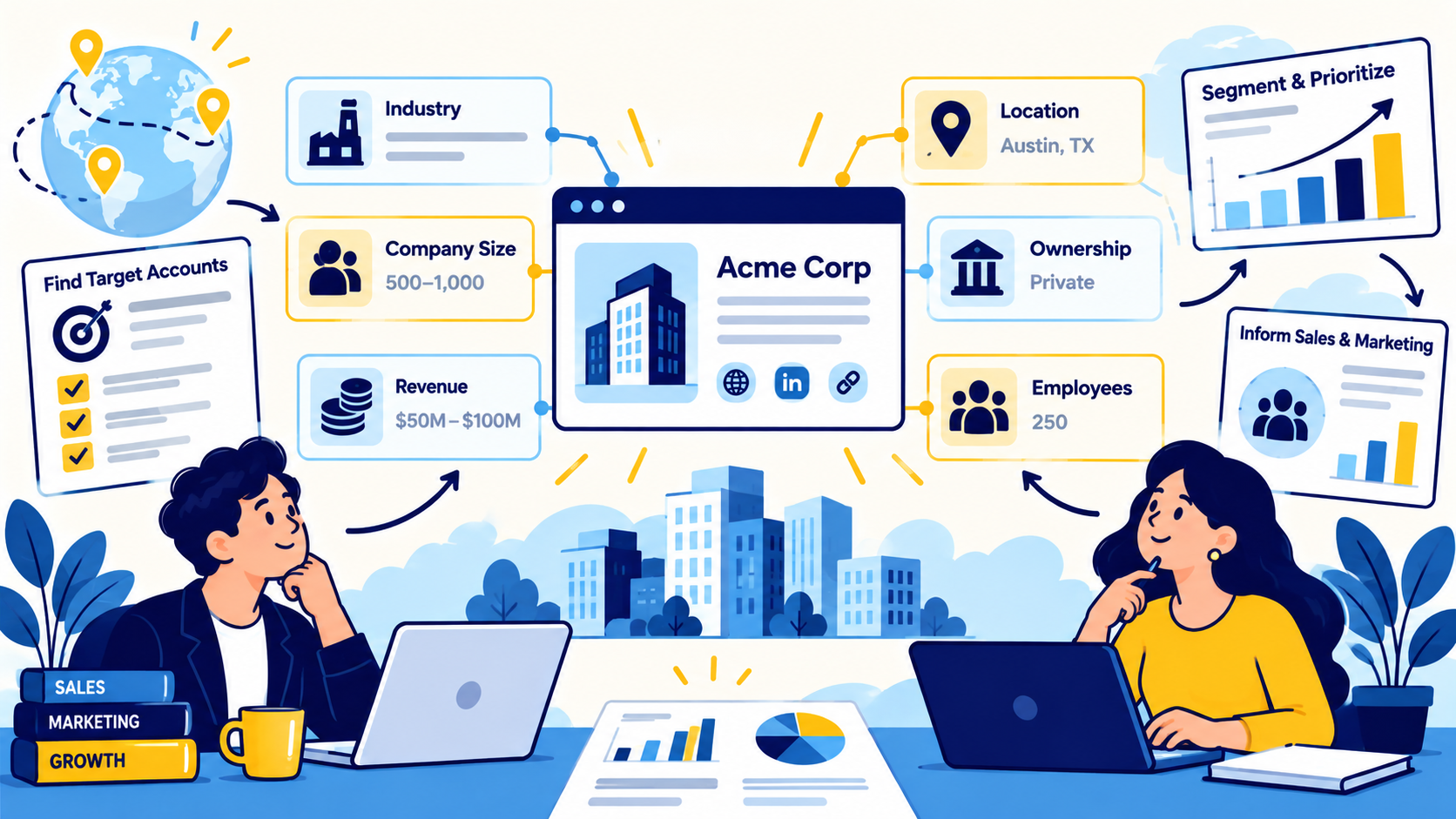
Firmographic data is company-level information used to describe and segment organizations. Common fields include company name, headquarters, industry, employee count, revenue, number of locations, ownership type, growth stage, and geographic footprint.
Salesforce describes firmographic data as the company version of customer demographic data, and common definitions from B2B platforms follow the same idea. The exact field set varies by use case, so a software company building an account list may care about employee count and industry while a supplier may care more about locations, facilities, or ownership structure.
- Industry and sub-industry
- Employee count or size band
- Revenue or revenue range
- Headquarters and operating locations
- Ownership or company type
- Growth stage, location count, or other business attributes
Start with the decision the field needs to support
A firmographic field is valuable when it changes qualification, segmentation, territory assignment, routing, personalization, reporting, or research priority. If nobody will act differently based on the field, maintaining it may not be worth the cost.
Define required fields before enrichment begins. A sales team targeting U.S. manufacturers with 100 to 1,000 employees may only need a handful of company attributes to build a strong first-pass account universe. Additional fields can be added where they improve prioritization or message relevance.
Use firmographics to build a target-account universe
Firmographics are especially useful at the beginning of prospecting because they narrow the market before individual contact research starts. Company-level filters can remove accounts that are too small, outside the service area, in the wrong industry, or otherwise poor fits.
That separation matters operationally. Researching decision makers and business emails is more expensive than filtering companies. Qualify the account first, then spend the deeper research time on the organizations that remain.
Expect sources to disagree on company size and classification
Firmographic fields are not always objective snapshots. Employee count can be estimated differently across sources. Revenue may be reported, modeled, or unavailable for private companies. Industry classifications can vary because a company may sell into one market while formally belonging to another category.
Create source and normalization rules before production begins. For example, decide whether employee count should be a point estimate or a range, which industry taxonomy the final file will use, and how to handle parent companies, subsidiaries, and multi-location businesses.
Keep source context and freshness visible
A firmographic value is more useful when the team knows where it came from and whether it is current enough for the decision. Fast-changing companies can move through size bands, open or close locations, change ownership, or reposition their business model.
For high-impact projects, keep a source URL, source name, verification date, or another freshness indicator. You do not need to expose every internal research step in the final deliverable, but you should be able to explain why a critical field is trusted.
Combine firmographics with contact and technographic data carefully
Firmographics answer who the company is. Contact data answers who works there and how to reach them. Technographic data describes the technologies the business uses. Intent and activity signals can add another layer about timing or behavior.
These categories become more powerful together, but only when the matching logic is controlled. A company-level attribute should not be copied across records unless the contact is confidently matched to the correct company entity.
Build QA around the fields that drive qualification
Not every field needs the same review depth. If employee count determines whether an account qualifies, that field deserves stronger checking than a descriptive field used only for context. If geography determines routing, location fields need consistent formats and clear definitions.
DataDabble's research approach is to define the field rules first, use paid and public sources where appropriate, normalize the output, then manually review ambiguous records instead of forcing every company into a value that looks complete but is not trustworthy.
Common questions
What is firmographic data?
Firmographic data is structured information about organizations, such as industry, company size, revenue, headquarters, ownership, and locations, used for B2B segmentation and decision-making.
What are common firmographic data examples?
Common examples include industry, employee count, annual revenue or revenue band, headquarters, operating locations, ownership type, and company size.
How is firmographic data different from technographic data?
Firmographic data describes the company itself. Technographic data describes the technologies and software associated with the company.
How often should firmographic data be refreshed?
Refresh frequency should match how quickly the field changes and how important it is to the workflow. High-impact fields used for qualification or routing deserve more frequent review than low-impact descriptive fields.
Final thoughts
Firmographic data describes organizations the way demographic data describes people. Industry, company size, location, revenue, ownership, and other business attributes help teams decide which accounts fit, how to segment them, and where to focus research or outreach. The useful question is not how many firmographic fields you can collect. It is which fields actually change a business decision.
Need help improving your business data?
DataDabble can research, clean, enrich, and maintain the records your team depends on.