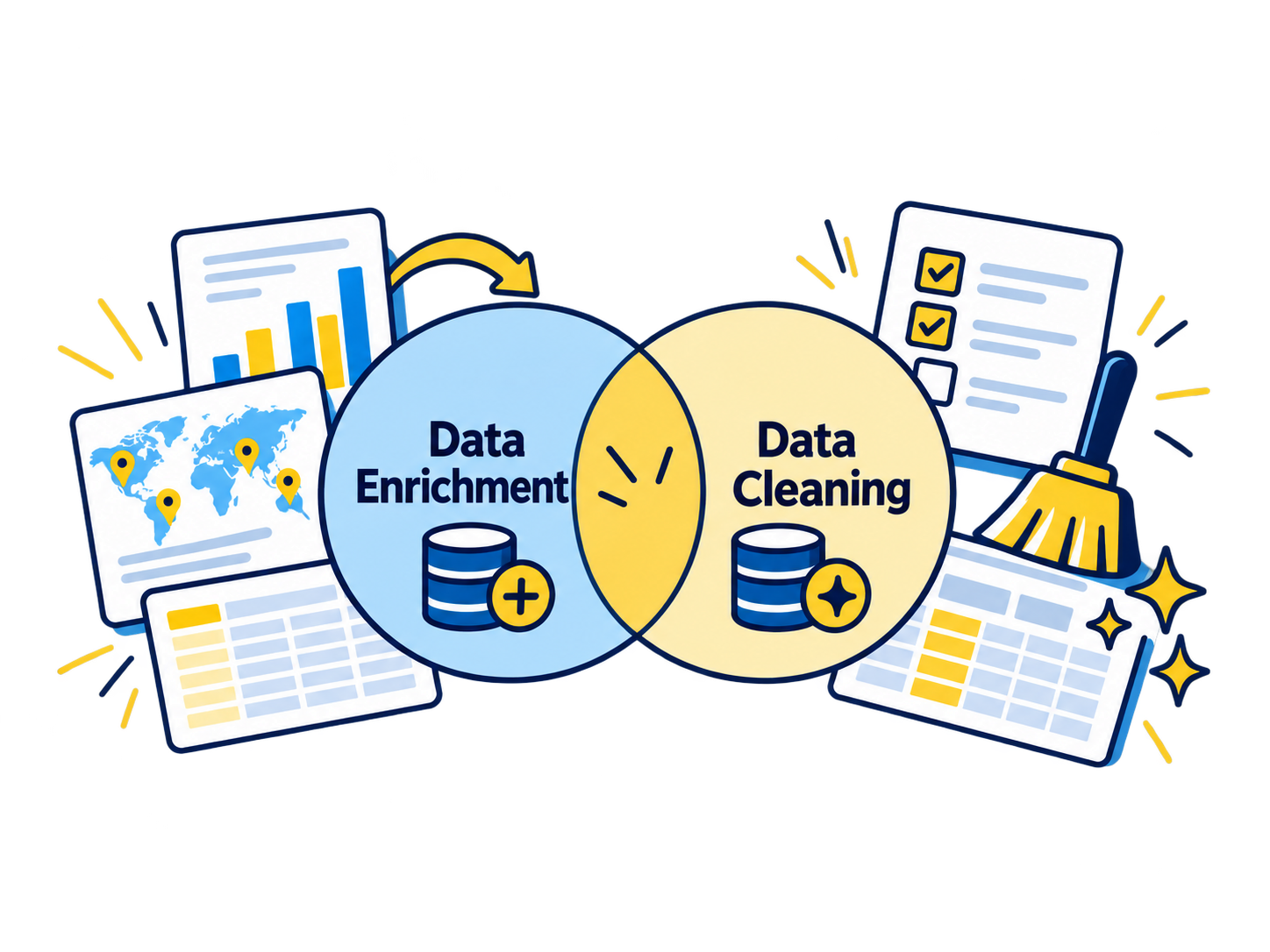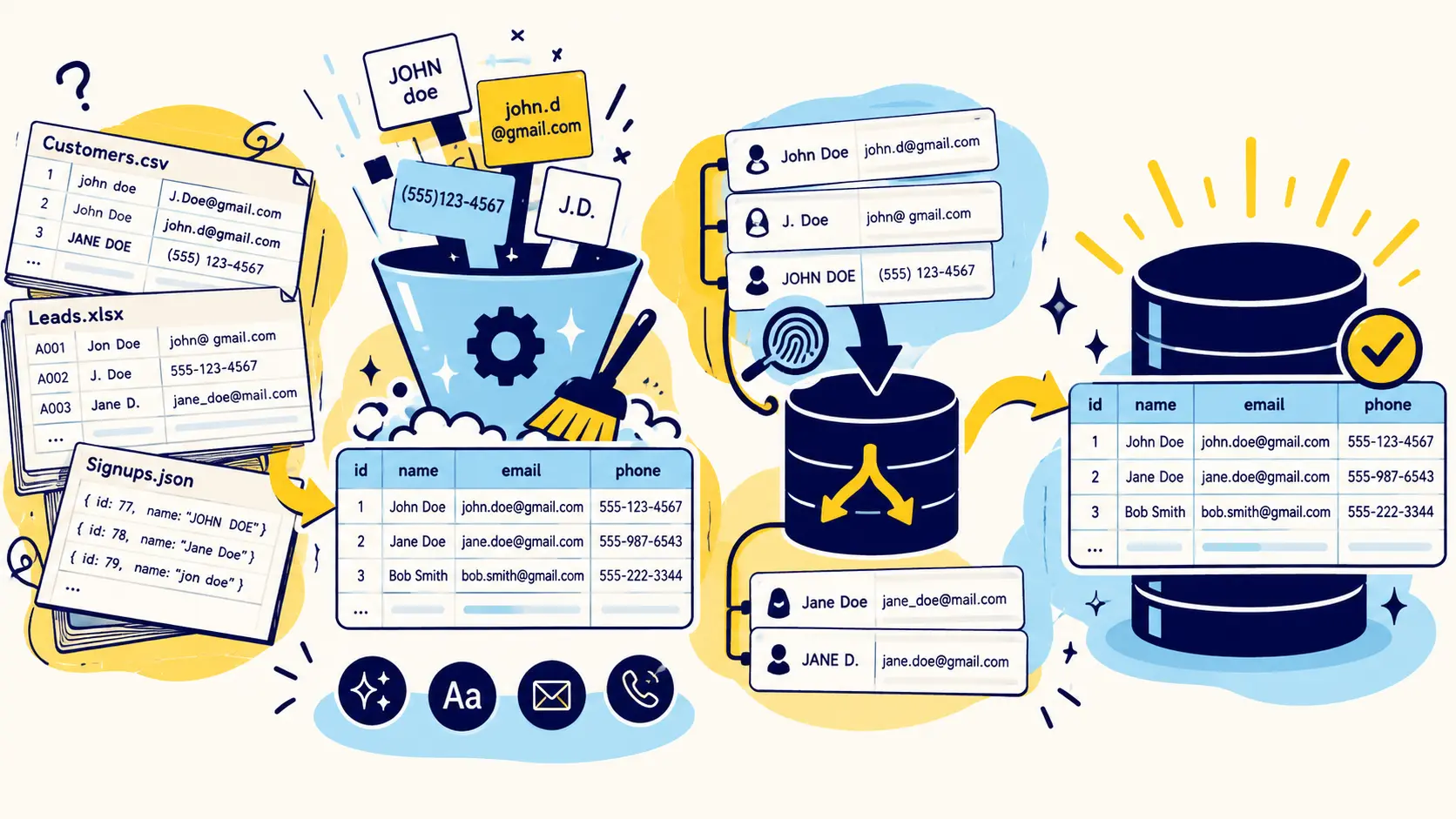
Cleansing fixes values; deduplication resolves entities
Data cleansing can standardize capitalization, dates, phone formats, country names, domains, addresses, titles, categories, and missing-value conventions. It can also validate whether values conform to business rules.
Deduplication operates at the record level. It asks whether two or more rows represent the same company, contact, product, location, account, or other entity and what should happen if they do.
Clean the matching fields before you deduplicate
Matching raw values creates unnecessary false negatives. Acme Inc., ACME, Inc., and Acme Incorporated may all represent the same business. Standardizing company names, domains, emails, phone numbers, and addresses gives the matching logic cleaner inputs.
This does not mean every field should be overwritten into one format before review. Keep raw values when they are useful for traceability, and create normalized fields specifically for matching where appropriate.
Profile the dataset before writing rules
Before cleansing or merging anything, profile the file. Measure missingness, value formats, duplicate rates, common suffixes, invalid values, and the fields that are actually populated well enough to support matching.
The profile determines what is realistic. A dataset with reliable website domains can support stronger company matching than a file with only free-text names. A contact file with consistent business emails can use different rules from one built mostly from names and employers.
Use deterministic and fuzzy matching for different jobs
Deterministic rules work well when strong keys exist, such as an exact normalized email, domain, SKU, or stable ID. Fuzzy matching is better for names, addresses, and other fields that legitimately vary.
A mature process usually combines both. Exact rules handle obvious cases efficiently, while fuzzy logic identifies candidate pairs that need supporting evidence or manual review.
- Standardize key fields
- Run exact-match rules
- Generate fuzzy-match candidates
- Check secondary evidence
- Merge with survivorship rules
- Run final QA and retain an audit trail
Do not let deduplication spread bad data
A merge can make data quality worse when the surviving record contains stale, incomplete, or unverified values. Field-level validation and source rules should determine what is allowed to survive.
For example, a duplicate contact record with a newer title may still contain an older company association. A company record with a complete address may still point to the wrong subsidiary. Merging requires judgment at the field level, not just the row level.
Separate deletion from consolidation
Deduplication does not always mean deleting a row. In some systems, related records need to remain separate because they represent different locations, business units, subscriptions, products, or historical states.
Define the intended dataset grain first. Consolidate true duplicates, preserve legitimate relationships, and mark uncertain records for review instead of forcing every similarity into a merge.
Build the rules into recurring operations
The strongest outcome is not a perfectly clean file on one day. It is a workflow that keeps new data aligned with the same standards. Apply normalization, validation, duplicate checks, and merge rules to future imports and enrichment jobs.
That turns cleansing and deduplication from a rescue project into a repeatable data operation.
Common questions
What is the difference between data cleansing and deduplication?
Cleansing improves the quality and consistency of values. Deduplication determines whether multiple records represent the same entity and how those records should be consolidated.
Should data be cleaned before deduplication?
Usually yes for the fields used in matching. Standardization reduces false differences and makes duplicate detection more reliable.
Does deduplication always mean deleting duplicate records?
No. Some records should be merged, some preserved as legitimate related entities, and some flagged for review depending on the dataset grain and business rules.
How do you keep a dataset deduplicated over time?
Apply the same normalization, validation, matching, and merge rules to new imports and integrations, then run recurring quality checks.
Final thoughts
Data cleansing and deduplication are closely related, but they solve different problems. Cleansing improves the quality and consistency of individual values. Deduplication determines when multiple records represent the same real-world entity. When the two are done in the wrong order, duplicates are harder to find and merges can spread bad values. When they are designed together, each step makes the next one more reliable.
Need help improving your business data?
DataDabble can research, clean, enrich, and maintain the records your team depends on.