What CRM data governance covers
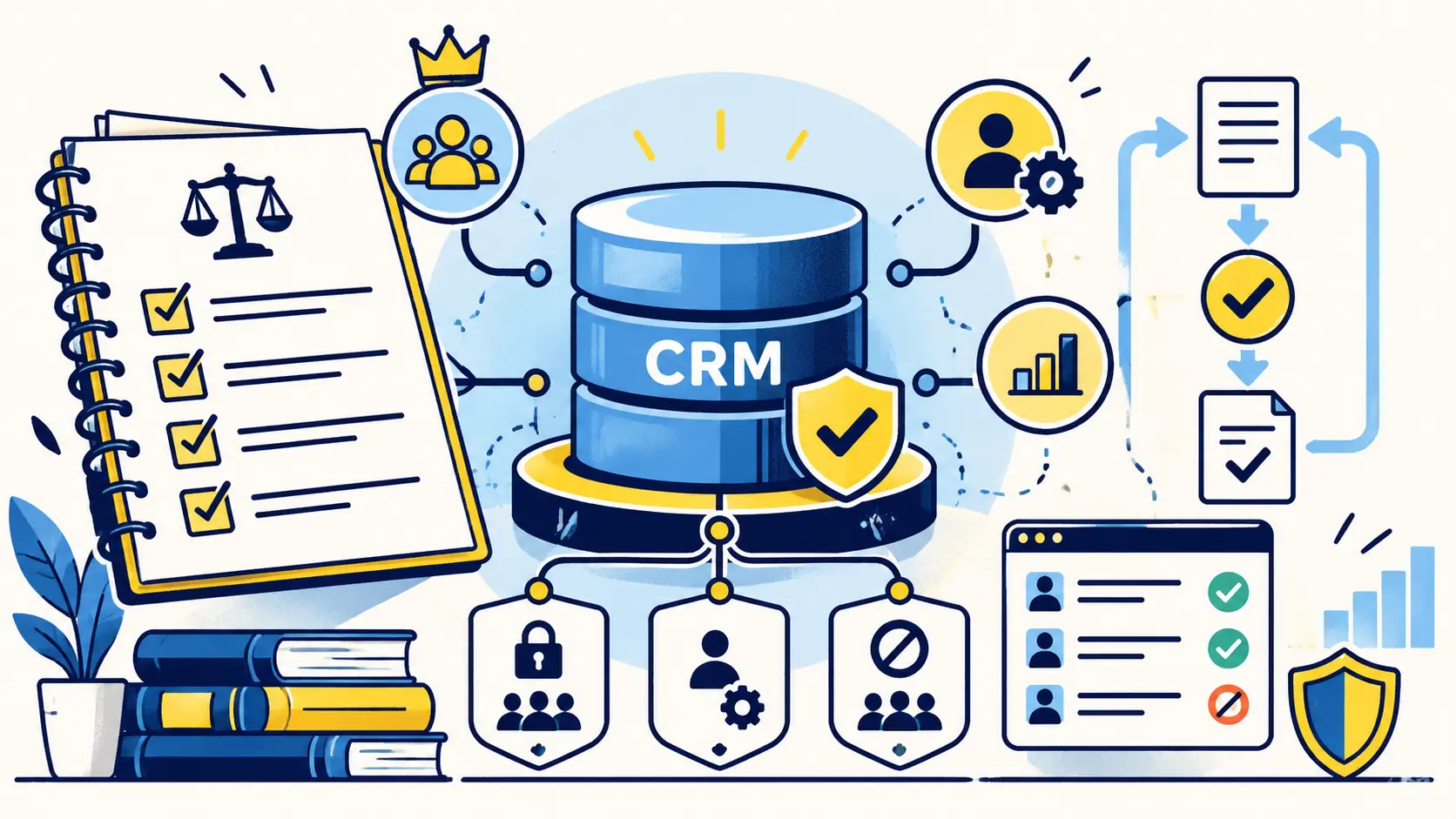
Governance sets the policies around CRM data. It defines ownership, access, required standards, approved sources, retention, security, and how changes are reviewed. Data management then executes those rules through systems and workflows.
Salesforce describes governance as the rules that keep data organized and secure, including access policies, classification, stewardship, and standards for quality and privacy. In a CRM, those ideas become very concrete: who can edit account ownership, which source wins when fields conflict, and when stale records should be archived.
Assign data owners and stewards
Governance fails when responsibility is abstract. Assign an owner for critical CRM objects and a steward for the fields that need ongoing review. Ownership means someone has the authority to define the rule and resolve exceptions.
For example, sales operations may own opportunity stages, marketing operations may own campaign attribution, and a data operations team may own company normalization, enrichment, duplicate handling, and bulk imports.
Use role-based access instead of universal editing
Not every user needs permission to change every field. Role-based access reduces accidental edits and protects sensitive information while still giving teams the data they need.
High-impact fields such as ownership, lifecycle stage, suppression status, legal entity identifiers, or integration keys may require tighter controls than ordinary notes or activity fields.
Govern the full data lifecycle
Governance should cover creation, use, update, archiving, deletion, and retention. A CRM that only defines how records are created but never how they leave the system will accumulate stale and unnecessary data indefinitely.
Lifecycle rules should address inactive contacts, former employees, duplicate accounts, closed businesses, opt-outs, restricted records, and any retention requirements that apply to the organization.
Make data quality part of governance
Quality standards turn governance from policy language into measurable operations. Define acceptable thresholds for required-field completeness, duplicate rate, stale records, invalid values, and other metrics that matter to the CRM.
Salesforce guidance connects governance directly to data quality, noting that governance establishes ownership, access rules, and standardized processes while data quality measures whether those rules are producing accurate, complete, consistent, and timely data.
Add change control for fields and integrations
A new CRM field can look harmless and still break automations, reports, imports, or integrations. Governance should require basic change control for important schema changes: define the business purpose, owner, allowed values, dependencies, migration plan, and deprecation plan before adding or changing a field.
Maintain the data dictionary as the CRM evolves. Documentation that is accurate once and ignored afterward becomes another source of bad data.
Keep governance practical
The strongest governance programs are not the ones with the longest policy documents. They are the ones users can follow. Start with the handful of fields and workflows that create the most risk, write clear rules, assign owners, automate what can be enforced, and review exceptions regularly.
If a rule cannot be explained in one or two sentences to the person entering the data, it probably needs to be simplified before it will work operationally.
Common questions
What is CRM data governance?
CRM data governance is the set of policies, roles, standards, and controls that define how CRM data is created, accessed, updated, retained, secured, and measured.
How is governance different from data management?
Governance defines the rules, ownership, and decision rights. Data management is the operational work of collecting, storing, cleaning, integrating, and maintaining the data under those rules.
Who should be on a CRM governance team?
Typical stakeholders include CRM administration, sales operations, marketing operations, data operations, IT or security, and business owners for high-impact fields and workflows.
What should a CRM governance policy include?
At minimum: field definitions, owners, source precedence, access rules, creation and import standards, lifecycle and retention rules, quality thresholds, change control, and an exception process.
Final thoughts
CRM data governance is the rulebook for how customer and account data should be created, changed, accessed, retained, and trusted. Governance is different from cleanup. Cleanup fixes a mess. Governance decides who is allowed to make the mess in the first place, which rules prevent it, and who owns the decision when something is ambiguous.
Need help improving your business data?
DataDabble can research, clean, enrich, and maintain the records your team depends on.