Start with qualification, not personalization
Before looking for clever talking points, verify whether the company belongs in the target market. Industry, location, company size, business model, customer type, growth stage, and technology environment can all matter more than a personalized opener.
A useful research workflow separates must-have qualification fields from nice-to-have context. If an account fails a core requirement, additional research is usually wasted effort.
- Confirm industry and business model
- Check location and operating footprint
- Validate company size against the target profile
- Confirm the company is active and relevant
Build a minimum viable account brief
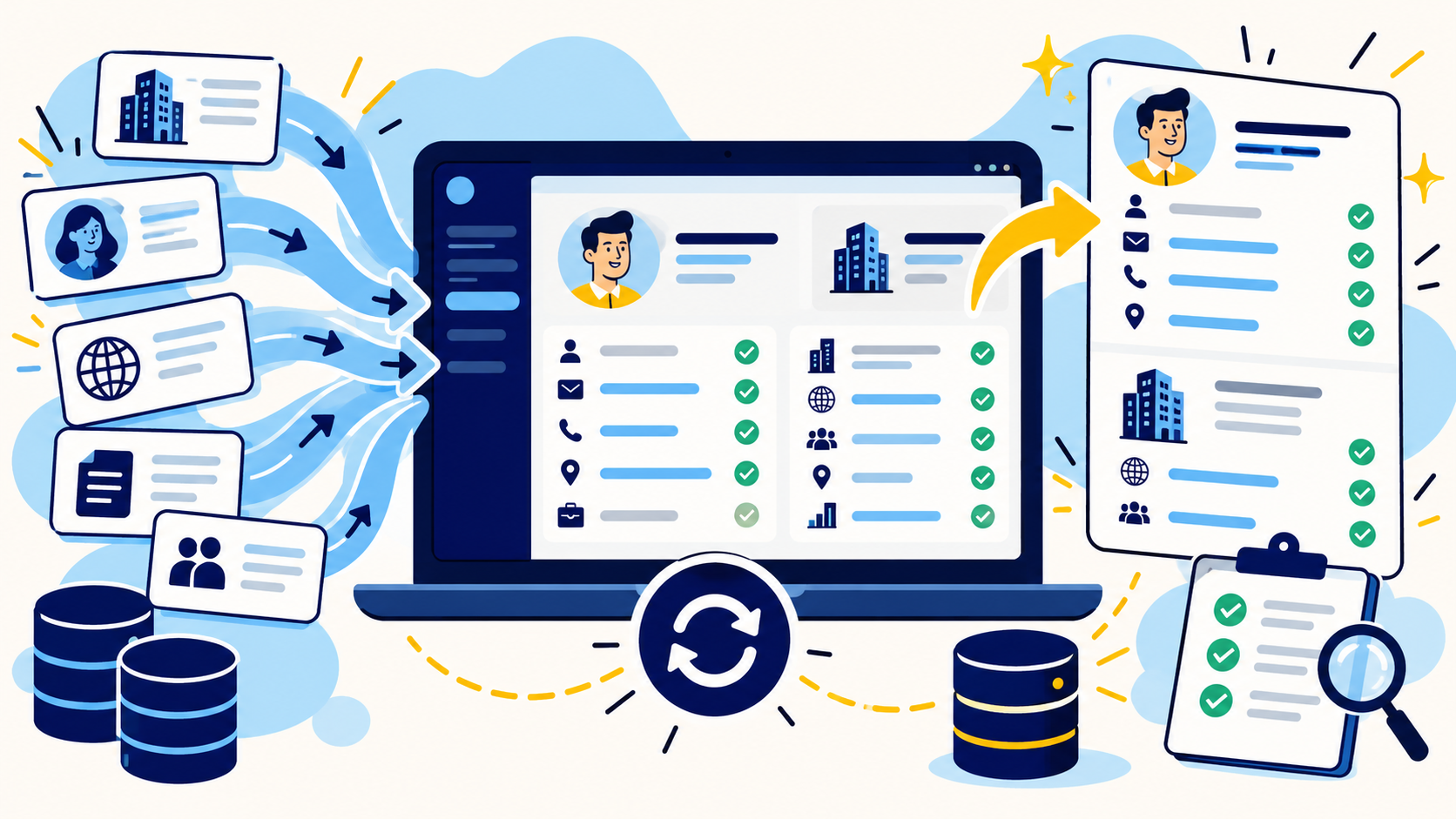
A practical account brief should be short enough to produce consistently. Typical fields include company name, website, headquarters, employee range, industry, a short description, relevant products or services, target contact function, and source links.
Only add fields that change targeting, prioritization, routing, or messaging. Research becomes expensive when teams collect information simply because it is available.
Use the strongest source for each field
Different sources are strong at different things. A company website may be best for current positioning and products. A public filing may be better for revenue or subsidiaries. A professional network may be better for current roles. A business database may be useful for discovery but should not automatically be treated as the final source of truth.
When two sources disagree, record the conflict and favor the source that is closest to the fact being verified and most recently updated.
Find the right person after the account qualifies
Contact research should follow account qualification. Start with the buying function and level of seniority, then identify people whose current role actually matches the problem you solve.
Titles vary significantly between companies. A title keyword alone is not enough. Review the person's current responsibilities, department, seniority, and relationship to the target function before adding them to the list.
Look for useful context, not manufactured personalization
Useful context can include a new product line, expansion into a region, a hiring pattern, a technology change, a recent acquisition, or a clear operational challenge. The information should connect naturally to the reason for outreach.
Avoid forcing irrelevant facts into messaging. A weak personalized sentence is not better than a concise message built around a genuine business fit.
Keep research traceable
For repeatable B2B research, store source URLs and dates for fields that are likely to change. This makes later verification easier and lets another researcher understand why a value was selected.
DataDabble commonly treats research as a structured dataset rather than a pile of notes. The account brief should be usable by sales, not just understandable to the person who researched it.
Know when to stop researching
Research is complete when the team can answer three questions: Is this account worth pursuing? Who is the right person or function? What relevant context supports outreach? If those answers are clear, more browsing often adds little value.
For large prospecting programs, define a time or field limit and route ambiguous records into a review queue instead of allowing edge cases to slow the entire list.
Common questions
How much company research should sales do before outreach?
Enough to confirm account fit, identify the right person, and find one or two relevant pieces of context. The exact depth should depend on deal value and account priority.
What fields belong in an account research brief?
Common fields include company name, website, industry, location, employee range, short description, target function, key contact, and source links.
Should every prospect receive the same research depth?
No. High-value strategic accounts usually justify deeper research than broad outbound lists.
Can company databases replace manual research?
They can accelerate discovery, but important or conflicting fields often still need source-level verification.
Final thoughts
Good outreach starts before the first email is written. The goal of company research is not to collect trivia. It is to confirm that an account fits, understand enough context to make the outreach relevant, and identify the right person without turning every prospect into a research project.
Need help improving your business data?
DataDabble can research, clean, enrich, and maintain the records your team depends on.