Start with the commercial question
Before selecting any technology field, define the decision it supports. Are you trying to find companies using a competing platform, accounts that already use a complementary system, businesses with a specific ecommerce stack, or organizations showing a certain level of technology maturity?
This keeps the project focused. Instead of collecting dozens of tools per company, you can build a short technology rule set that directly affects qualification or prioritization.
- Competitive technology present
- Complementary technology present
- Required platform or integration environment
- Technology maturity or complexity signal
- Website or ecommerce platform relevant to the offer
Use technographics after the account fits the ICP
Technology should usually refine a target market, not replace basic company qualification. A perfect technology match can still be a poor account if the business is outside the target geography, too small, in the wrong industry, or otherwise unable to buy.
A cleaner workflow qualifies companies using firmographic criteria first, then layers technographic signals onto the remaining accounts. That makes the technology field more meaningful and reduces wasted research.
Turn technology signals into account segments
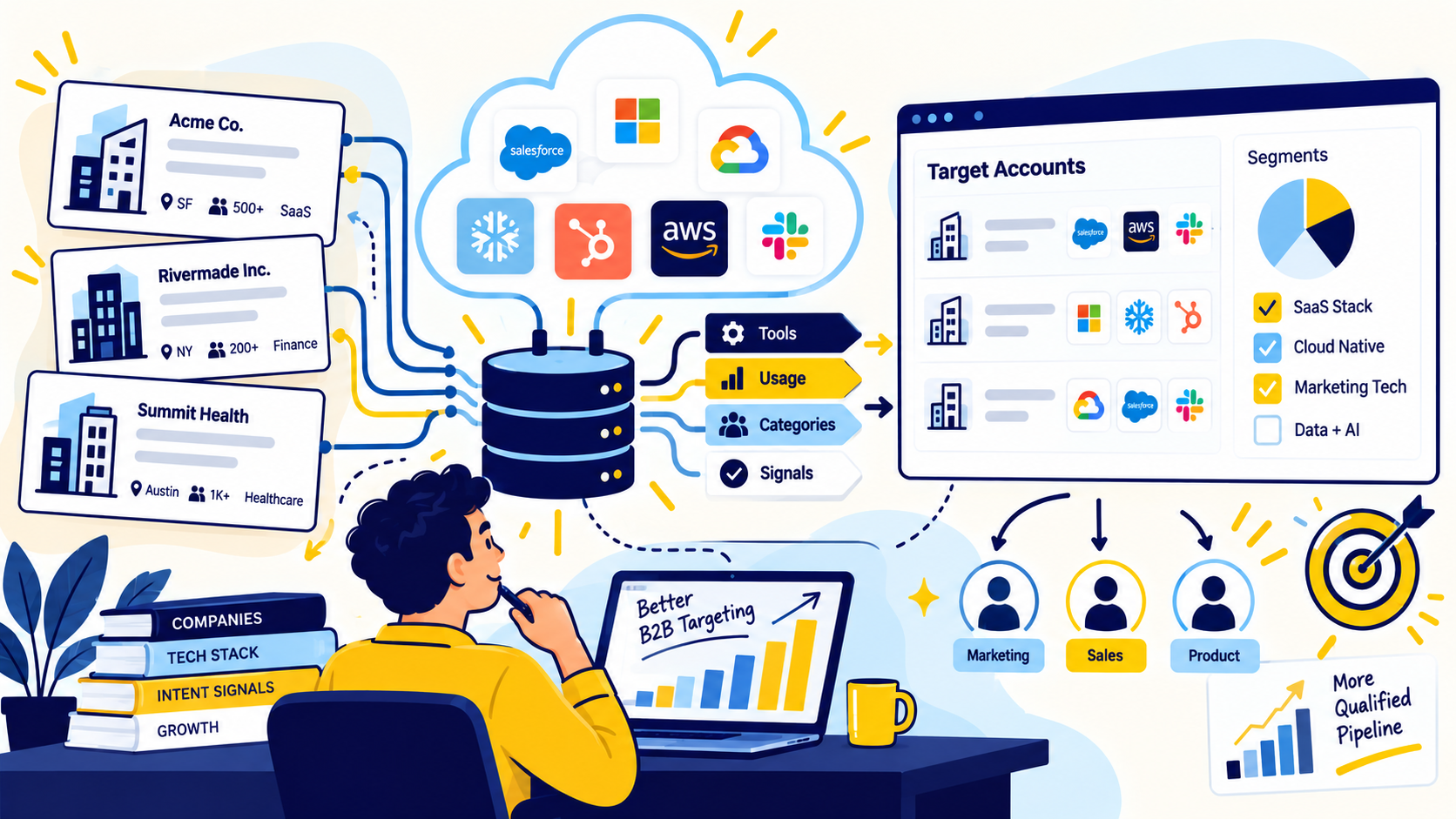
The simplest use of technographics is segmentation. Accounts can be grouped by platform, technology category, detected competitor, complementary system, or another relevant stack condition. Those segments can then support different research priorities, messaging, or service offers.
For example, a catalog operations provider might separate ecommerce brands by platform or marketplace infrastructure before researching the people responsible for catalog management. A data integration provider might segment accounts by CRM or warehouse technology.
Build confidence rules before using the field for outreach
A technology signal should have a minimum evidence standard if it changes the message a prospect receives. A public website detection may be strong enough for one campaign and too weak for another. High-value or highly personalized outreach deserves stronger verification.
Set simple labels such as confirmed, likely, historical, and unknown, or use another confidence structure that fits the team. The important part is to avoid converting uncertainty into a binary yes or no field without context.
Pair the technology with the right contact role
Once the account and technology signal are qualified, identify the people most likely to own or influence that technology. The right contact depends on company size and use case. An ecommerce manager, operations lead, RevOps director, IT leader, marketing operations manager, or founder may all be appropriate in different environments.
DataDabble's B2B research workflow keeps company qualification, technology verification, and contact research as separate steps. That prevents a valid contact from being attached to an account that never met the technology criteria.
Do not treat missing detection as a negative signal
One of the easiest mistakes is assuming that a technology is absent because a public detection tool did not find it. Many important systems are not observable from a website, and public signals can disappear even while the software remains in use.
Use unknown as a real state. If the technology is essential to qualification, move uncertain accounts into a research queue rather than automatically rejecting them.
Measure whether technographics improve the list
The value of technographic targeting should be visible in the final account set. Compare qualification rates, manual-research effort, sales acceptance, reply quality, or another metric that fits the workflow. If the technology filter does not improve the usefulness of the list, it may be too broad or weakly connected to the offer.
Good technographic targeting reduces noise. It should make the account universe more specific, not simply make the spreadsheet wider.
Common questions
What is B2B technographic data used for?
B2B teams use technographic data to refine account targeting, segment companies by technology stack, prioritize research, identify compatibility or replacement opportunities, and add context to outreach.
Should technographic data replace firmographic targeting?
Usually no. Firmographic criteria determine whether the company fits the target market, while technographic data adds another layer of fit or context.
How should uncertain technology detections be handled?
Keep them separate from confirmed signals and route important unknowns for additional research instead of treating them as definite yes or no values.
Which technographic fields should a B2B team collect?
Collect the technology fields that directly change qualification, segmentation, prioritization, or messaging. Avoid adding broad stack data that nobody will use.
Final thoughts
B2B technographic data becomes useful when a technology signal changes who you target or how you approach the account. The goal is not to build the widest possible technology profile. It is to identify the few technologies that indicate fit, compatibility, replacement opportunity, maturity, or another condition that matters to the buying motion.
Need help improving your business data?
DataDabble can research, clean, enrich, and maintain the records your team depends on.