Use multiple sources for complementary strengths
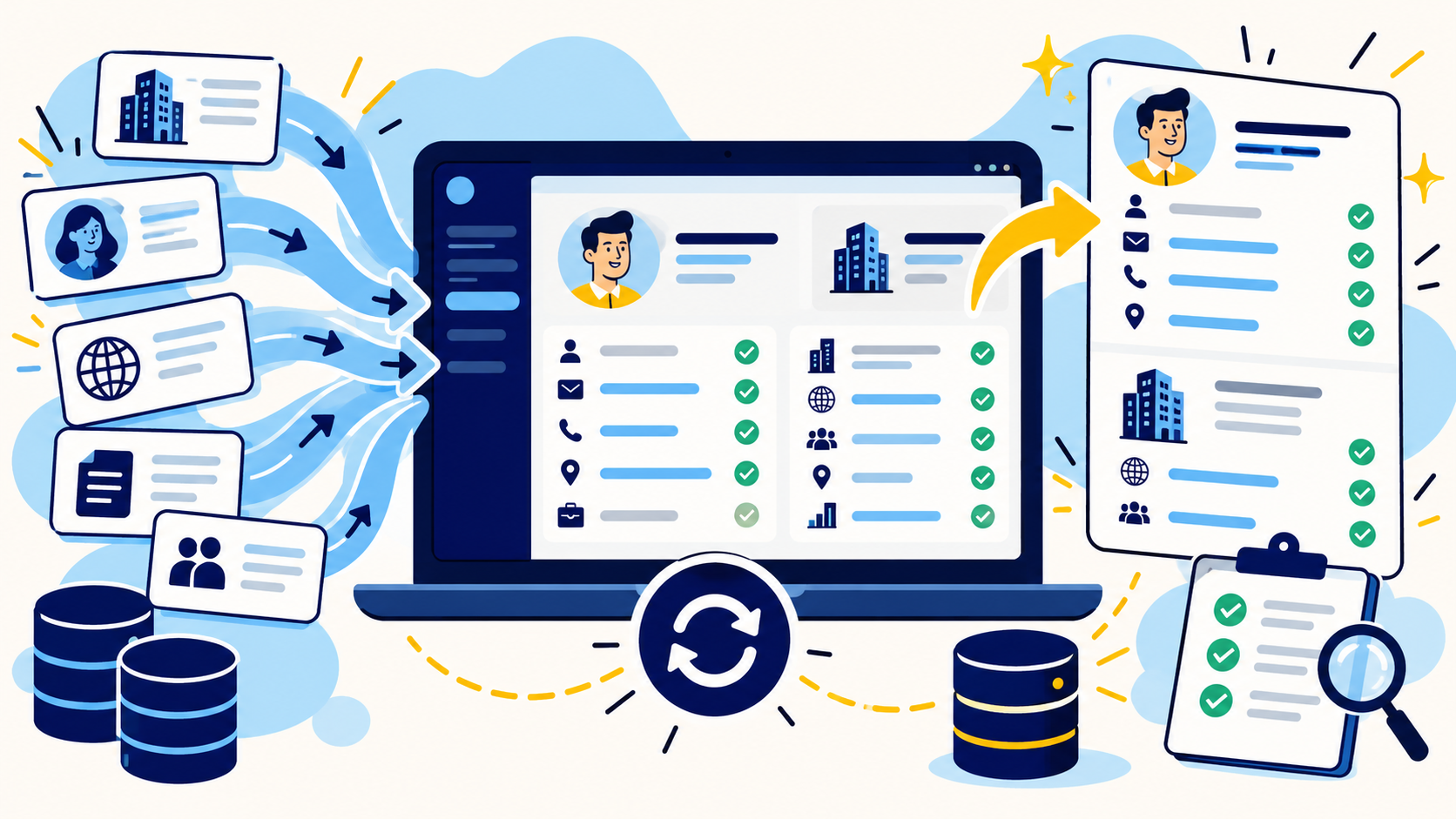
One source may be strong for legal identity, another for current positioning, another for people, and another for technology signals. Combining them can create a more complete account view than any one source provides.
The purpose of triangulation is not to make every source vote on every field. It is to use different evidence where each is strongest and to test important conclusions against independent information when appropriate.
Define field ownership before research starts
Create a source plan that says which source type is preferred for each field. For example, a registry may own legal entity status, the company website may own product descriptions, and a current professional profile may be preferred for role verification.
Field ownership prevents researchers from choosing whichever value appears first and improves consistency across a team.
Normalize entities before combining records
Different sources may spell company names differently, use alternate domains, list subsidiaries separately, or attach contacts to parent companies. Resolve the entity before merging attributes.
Stable identifiers such as canonical domain, registration number, marketplace seller ID, or another source-specific ID can reduce accidental merges and duplicate records.
Build explicit conflict rules
When sources disagree, use a rule hierarchy rather than judgment on the fly. Consider source authority, directness, timestamp, measurement definition, and whether one source is merely repeating another.
Some conflicts should not be resolved automatically. A review queue is better than overwriting a high-value field with an uncertain value.
Record provenance at the field level when it matters
A single record may contain fields from several sources. If the project is high-value or likely to be refreshed, store the source URL, source type, date, and confidence next to important fields or in linked provenance columns.
This makes future updates much easier because researchers can revisit the exact evidence rather than restarting the investigation.
Use triangulation to strengthen conclusions, not decorate them
Independent evidence is most useful when the sources have different weaknesses. Multiple copies of the same underlying claim do not meaningfully strengthen it.
If several genuinely independent sources converge, confidence can increase. If they diverge, the disagreement itself is useful information and should be investigated rather than averaged away.
Design QA around the highest-risk fields
Not every field deserves the same review depth. Focus QA on fields that drive targeting, pricing, compliance, routing, or strategic decisions. Sample lower-risk fields and deeply review exceptions or conflicts.
A strong multi-source workflow produces data that is richer than a single-source export while remaining explainable, traceable, and consistent enough for business use.
Common questions
What is multi-source business research?
It is the structured use of multiple sources to build or verify a business dataset, with explicit rules for source selection, conflicts, provenance, and QA.
Does using more sources always improve accuracy?
No. Additional sources help only when they add independent, relevant evidence or a stronger source for a particular field.
How should conflicting data be handled?
Use predefined rules based on authority, recency, directness, and definitions, then send unresolved high-impact conflicts to review.
What is field-level provenance?
It is a record of where an individual value came from, often including the source URL, source type, access date, and confidence.
Final thoughts
The best business datasets rarely come from one source. The challenge is not collecting more evidence. It is combining sources without creating duplicate entities, contradictory fields, or false confidence. Multi-source research needs explicit rules for what each source contributes and what happens when they disagree.
Need help improving your business data?
DataDabble can research, clean, enrich, and maintain the records your team depends on.