Keep one canonical product record
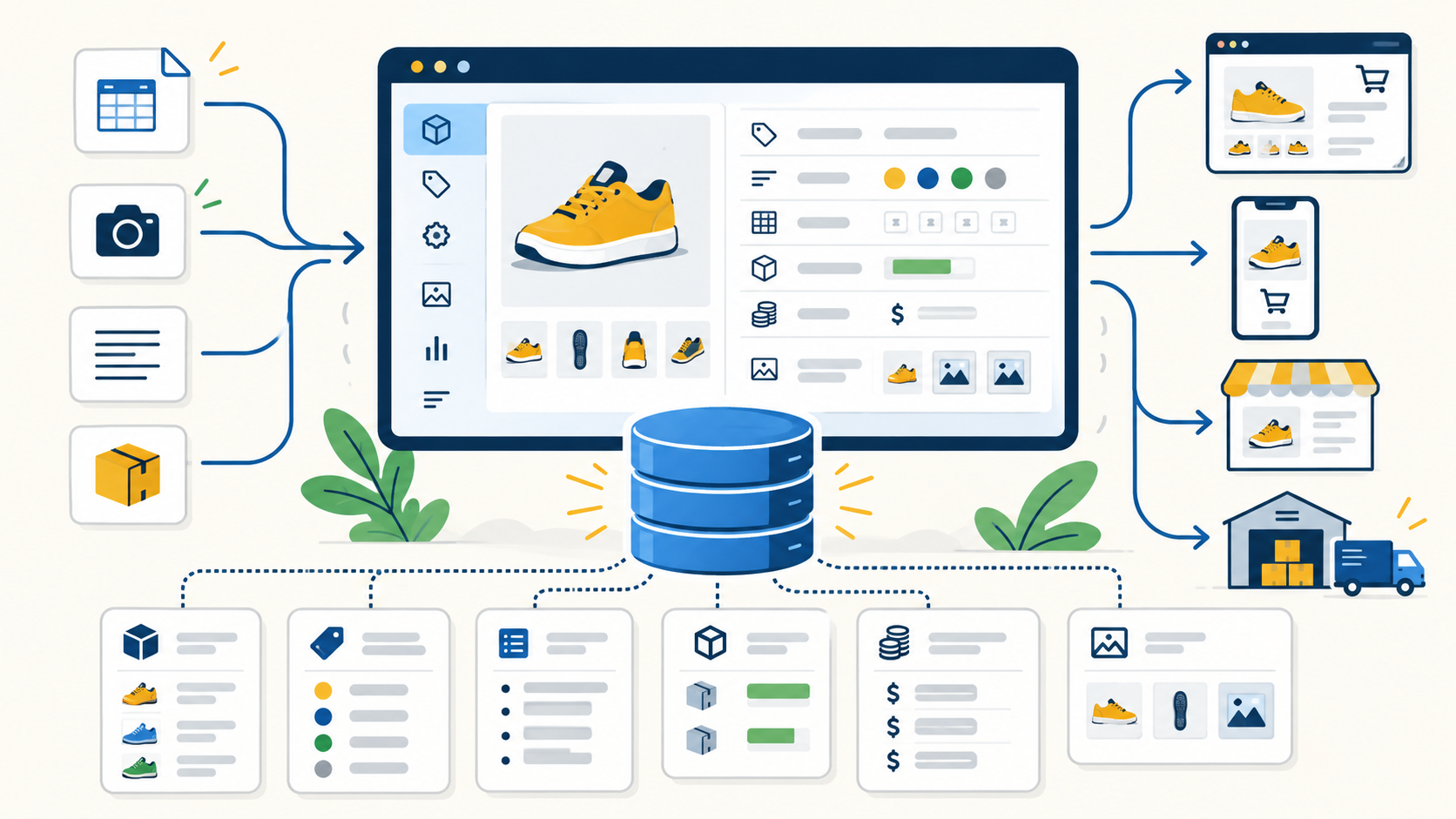
Core product facts should have a defined home. SKU, brand, identifiers, dimensions, pack count, ingredients or materials, base title, variation structure, and other shared attributes should not be edited independently in five different channel files.
A canonical record does not mean every channel receives the same content. It means the team knows which values are source facts and which values are destination-specific transformations.
Create a separate mapping layer for each channel
Amazon, Walmart, Shopify, Google Merchant Center, eBay, and other destinations can use different category trees, field names, controlled values, title rules, image requirements, and variation logic.
Maintain those differences in mappings or channel-specific fields. Do not contaminate the source record just to satisfy one destination.
Define ownership before changes happen
Multichannel maintenance gets messy when several teams can change the same field without knowing who owns it. Assign responsibility for identifiers, operational specifications, marketing copy, compliance content, pricing inputs, inventory, and marketplace-specific attributes.
When a value changes, the owner should know whether the update belongs in the source catalog, a mapping rule, or only one destination.
Separate content, inventory, and price workflows
Product content, inventory, and price often move at different speeds. Treating them as one giant catalog update can create avoidable risk.
Use separate controls and refresh cadences where possible. A title change should not accidentally overwrite inventory. An inventory sync should not alter variation content.
Monitor exceptions instead of checking everything manually
Large catalogs are maintained by focusing attention on change and failure. Watch for rejected listings, suppressed products, missing required attributes, unmapped values, broken images, duplicate identifiers, stale inventory, and channel-specific warnings.
Build queues around those exceptions so the team spends time on records that need judgment instead of repeatedly reviewing healthy products.
Use verification dates and change history
Some fields are relatively stable. Others change frequently. Add verification dates or refresh logic for information that can become stale, and preserve enough change history to understand why an important field was updated.
This is especially valuable when a marketplace rejects a listing after a rule change because the team can distinguish a new channel requirement from a source-data problem.
Audit the catalog on a schedule
A healthy multichannel catalog still needs recurring QA. Review a sample of live listings against the source data, compare channel error reports, check required-field coverage, inspect variation families, and confirm that mappings still reflect current destination requirements.
The objective is not perfection on every optional field. It is reliable product identity, accurate critical content, controlled transformations, and a process that catches problems before they spread across channels.
Common questions
What is a multichannel product catalog?
It is a product dataset that supports selling the same catalog across multiple destinations such as marketplaces, storefronts, feeds, and retailer integrations.
Should every channel use the exact same product data?
No. Shared product facts should come from a canonical source, while channel-specific requirements should be handled through mappings or destination-specific fields.
How often should a multichannel catalog be audited?
The cadence depends on catalog size and change frequency, but high-impact exceptions and listing errors should be monitored continuously while deeper catalog QA can run on a regular scheduled cycle.
What usually causes catalog drift?
Common causes include direct edits inside marketplaces, undocumented mapping changes, unclear field ownership, stale source data, and channel requirements that changed without a corresponding update to the workflow.
Final thoughts
A multichannel catalog becomes difficult when every destination starts acting like its own source of truth. The goal is not to make every channel identical. The goal is to maintain one reliable product foundation, translate it deliberately for each destination, and know exactly where channel-specific differences belong.
Need help improving your business data?
DataDabble can research, clean, enrich, and maintain the records your team depends on.