Test the provider on your market, not its headline database size
A provider can have excellent overall coverage and still be weak in a narrow industry, company-size band, geography, or private-company segment. Start with a representative sample of target accounts rather than a vendor-selected demo list.
Include easy, average, and difficult companies. Then measure whether the provider finds the correct entity and returns the fields you actually need. This produces a much more useful signal than a generic record-count claim.
- Use real target accounts from your ICP
- Include smaller and less obvious companies
- Test more than one geography if your market spans regions
- Measure field-level fill rates instead of total database size
Define each critical field before comparing vendors
Two providers can both offer employee count, revenue, industry, and headquarters while defining or sourcing those fields differently. Decide what each field needs to mean in your workflow before comparing results.
For example, employee count might mean total global employees, a modeled estimate, a range, or employees visible through a professional network. Revenue can be reported, estimated, or unavailable for private firms. Industry can use a vendor taxonomy rather than the one your CRM already uses.
Score accuracy and freshness separately from coverage
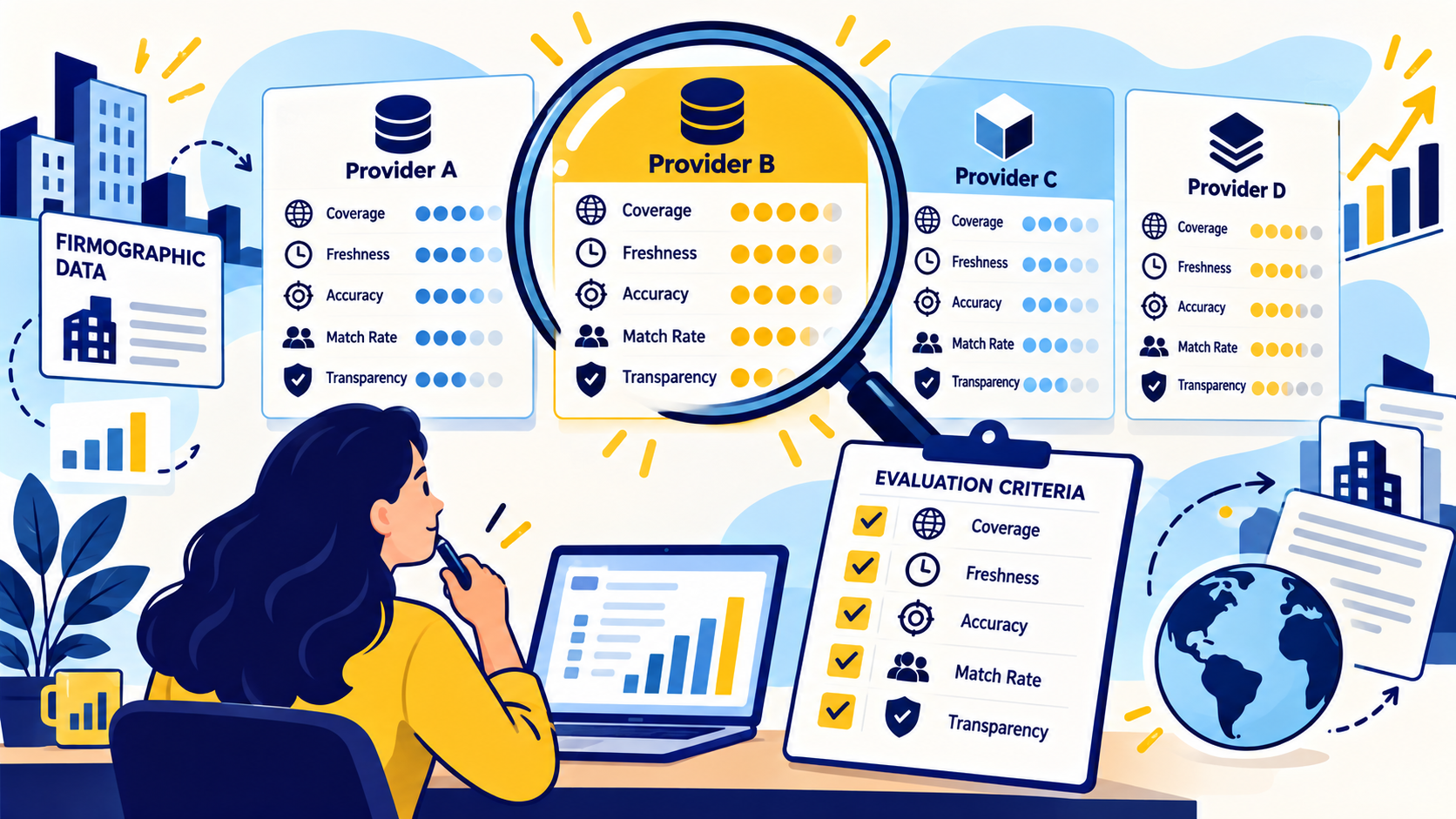
Coverage asks whether a field is populated. Accuracy asks whether it is correct. Freshness asks whether it is current enough for the task. A provider that fills every row with stale or weakly matched values can create more work than one that leaves uncertain records blank.
Build a simple scorecard by field. For a sample of companies, compare provider values with reliable public or first-party sources and record confirmed, incorrect, stale, missing, and ambiguous results.
Inspect company matching and entity resolution
Firmographic enrichment depends on matching the input record to the correct company. Similar names, subsidiaries, franchises, holding companies, acquisitions, and regional entities can all create false matches.
Test whether the provider can use domains, websites, stable identifiers, or other strong matching keys. Review how it handles parent-child relationships and whether the returned company is the entity your team actually intends to target.
Evaluate the workflow after the data is found
The best data source can still be a poor operational fit. Review export limits, saved searches, API access, CRM integrations, field mapping, overwrite controls, bulk enrichment, update behavior, and how duplicates are handled.
For a custom research workflow, clean CSV exports and flexible filters may matter most. For an established CRM, field-level update rules and matching controls may matter more than raw search features.
Understand what still requires human research
No provider should be expected to resolve every ambiguous company automatically. Niche classifications, private-company details, subsidiaries, location counts, or custom business attributes can require manual research and judgment.
DataDabble uses paid data platforms as accelerators rather than unquestioned sources. When a field drives qualification and sources disagree, the record is reviewed manually or flagged instead of forcing a value into the dataset.
Choose based on cost per usable record, not cost per credit
Vendor pricing models vary, which makes direct price comparisons difficult. A cheaper credit can be expensive if a large share of the returned records still need correction, research, or manual matching.
Estimate the real cost of producing a usable record. Include platform fees, credits, staff time, cleanup, verification, duplicate handling, and any second source needed to close gaps. That calculation gives you a more realistic view of provider value.
Common questions
What should I look for in a firmographic data provider?
Evaluate real-market coverage, field definitions, accuracy, freshness, entity matching, exports or integrations, update controls, and the amount of manual QA required after enrichment.
Which firmographic provider has the best data?
There is no universal best provider. Performance varies by geography, company size, industry, field, and workflow, so a representative sample test is more reliable than a generic ranking.
How should I test a firmographic database?
Create a sample of real target accounts, define expected fields, compare returned values against trusted references, and score confirmed, stale, missing, incorrect, and ambiguous records by field.
Is the largest database usually the best choice?
No. Overall database size does not guarantee strong coverage or accuracy for your specific market and fields.
Final thoughts
Firmographic data providers can look very similar in a feature comparison and perform very differently on your actual market. The right evaluation is not which vendor claims the largest database. It is whether the provider reliably covers the companies and fields you care about, explains enough about freshness and matching to manage risk, and fits the workflow that happens after the export.
Need help improving your business data?
DataDabble can research, clean, enrich, and maintain the records your team depends on.