1. Official company websites
Company websites are usually the first place to confirm what a business says it does, where it operates, which products or services it offers, and who appears on its leadership or team pages. They are especially useful for current positioning and first-party descriptions.
Their limitation is selective disclosure. Private companies may publish little about employee size, revenue, ownership, or internal structure, so the website is often a starting point rather than the entire answer.
2. SEC EDGAR and other public records
For U.S. public companies, SEC EDGAR is one of the strongest free research tools available. Annual 10-K reports, quarterly 10-Q reports, and current 8-K filings can provide audited financial statements, business descriptions, risk factors, material events, subsidiaries, and other disclosures.
State corporate registries and other government sources can help confirm legal entity names, incorporation details, registrations, or standing. These sources are powerful for verification but do not cover every private-company attribute a commercial project may need.
3. B2B company and contact databases
Platforms such as ZoomInfo, Apollo, Seamless, and similar databases can accelerate company and contact research by providing firmographics, roles, business contact information, and filters. They are valuable when speed and scale matter.
The weakness is that database coverage and freshness vary by segment. Niche companies, small firms, non-U.S. markets, recent job changes, and custom attributes often require additional verification. Treat provider data as an input to research, not automatic truth.
4. LinkedIn and professional sources
LinkedIn and Sales Navigator are especially useful for confirming current roles, departments, seniority, reporting context, and company affiliation. They can also help identify decision-makers and understand how a team is structured.
Professional profiles are strongest for identity and role context. They should not be treated as a complete source for company financials, legal information, or every contact field.
5. Search, news, and industry sources
Search engines, trade publications, local business journals, press releases, industry associations, and reputable news databases can fill gaps that structured databases miss. They are useful for acquisitions, expansions, leadership changes, partnerships, new locations, and market context.
The challenge is source quality. Search results mix first-party statements, journalism, directories, scraped pages, and outdated content. The researcher still has to decide which source deserves trust.
6. Specialized research tools
Some projects need technology-stack data, web traffic estimates, funding data, import-export records, location intelligence, patent records, or other specialized sources. Competitive and market intelligence platforms can also aggregate diverse internal and external information for strategic research.
Use specialized tools when the field actually changes the decision. Buying another dataset because it exists can make research more expensive without making the answer better.
How to choose the right research stack
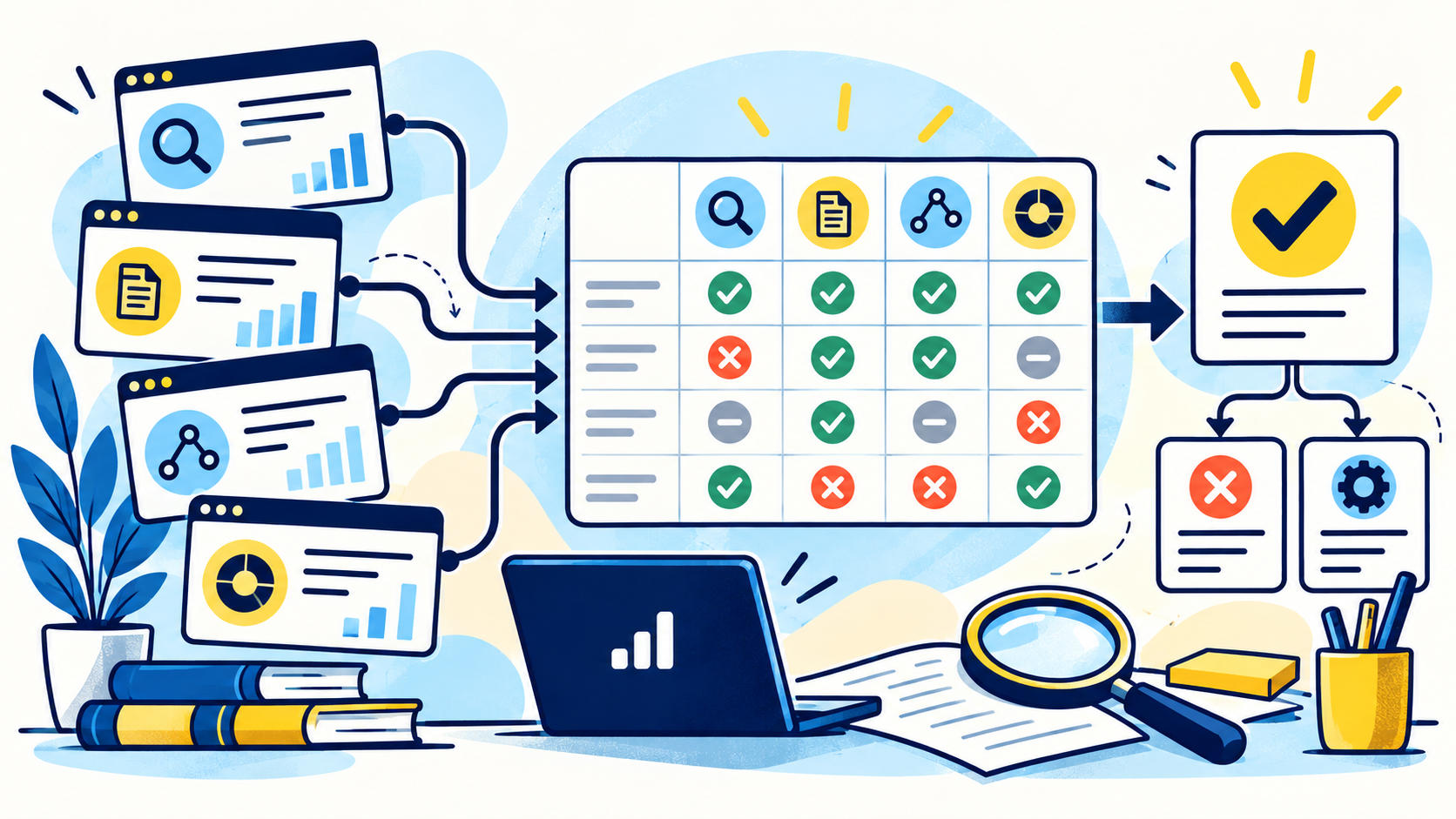
Build the stack around the project schema. Assign a preferred source to each critical field, a backup source for conflicts, and a manual-review rule for anything ambiguous. This is more reliable than telling a researcher to use a list of ten tools in no particular order.
A practical stack often combines first-party websites, public records, one or two structured databases, professional sources, and targeted web research. The value is not the number of subscriptions. It is the ability to move from a question to a defensible answer efficiently.
Common questions
What are the best tools for company research?
The best tools depend on the field. Company websites, SEC EDGAR, state registries, B2B databases, LinkedIn or Sales Navigator, search, news databases, and specialized industry sources all solve different parts of the research problem.
Can one company database replace manual research?
Usually not for custom or high-accuracy work. Databases are efficient for common fields, but niche companies, recent changes, conflicting values, and custom attributes often need manual verification.
Is SEC EDGAR free?
Yes. The SEC provides free public access to EDGAR, which contains filings and company information for public issuers and other filers.
How many research tools should a team use?
Use the minimum set needed to cover the required fields reliably. A defined source hierarchy is usually more useful than a large stack with overlapping data.
Final thoughts
The best company research stack is not one tool. Different tools answer different questions, and the fastest workflow comes from knowing where each category is strong, where it is weak, and when to verify a result somewhere else. A database that is excellent for employee estimates may be poor for legal entities. A company website may be authoritative about products but vague about revenue. Tool selection should follow the field you need.
Need help improving your business data?
DataDabble can research, clean, enrich, and maintain the records your team depends on.